See property changes before they become underwriting blind spots.

Gryd by BuildZoom Data helps insurance and underwriting teams use jurisdiction-verified permit, property, contractor, and project data to confirm improvements, understand risk, support rate adequacy, and reduce manual research.
Undeclared property changes increase risk.
A roof replacement, solar installation, major renovation, HVAC upgrade, electrical update, plumbing work, or addition can change how a property should be understood. But those changes are easy to miss when teams rely on stale property records, self-reported updates, or manual permit searches across local portals.
Gryd helps insurance teams see documented construction activity tied to the property, the contractor, the permit, and the jurisdiction that approved the work.
Improvements are often missed
Important property updates may not be reflected in the systems underwriting teams already use.
Manual permit research does not scale
Checking local portals one property at a time slows down underwriting, renewal, claims, and portfolio workflows.
Property details can be incomplete
Roof age, renovation history, solar installs, HVAC updates, and other changes may be unclear without permit history.
Risk signals need documentation
A verified permit record gives teams stronger context than a guess, assumption, or outdated property profile.
Add verified construction activity to property risk decisions.
Gryd gives insurance and underwriting teams a clearer view of what work was permitted, when it happened, who was involved, and how the property may have changed over time.

Confirm property improvements
Use permit history to identify updates like roofing, solar, HVAC, electrical, plumbing, additions, renovations, and repairs.
Support rate adequacy
Use documented improvement timelines and property changes to better understand whether the current policy reflects the current property.
Reduce premium leakage
Identify undeclared improvements or changes that may affect coverage, pricing, or renewal review.
Strengthen claims and fraud review
Review permits, contractor activity, and construction records that may help validate claims or investigate suspicious activity.
Improve portfolio visibility
Analyze property changes, permit velocity, and construction activity across markets, jurisdictions, and books of business.
Reduce manual research
Bring permit and contractor signals into a more usable workflow instead of relying on slow one-off searches.
Make underwriting decisions with more property context.

Fewer hidden property changes
See documented improvements that may not appear in standard property records or customer-provided information.
Faster risk review
Give teams a cleaner way to access permit and property change context without searching local records manually.

Better renewal context
Use permit history and recent improvements to support renewal review, re-inspection prioritization, and coverage updates.
Stronger risk models
Add verified construction signals, permit velocity, property changes, and contractor activity to models and analytics workflows.
Construction signals that can support insurance workflows.
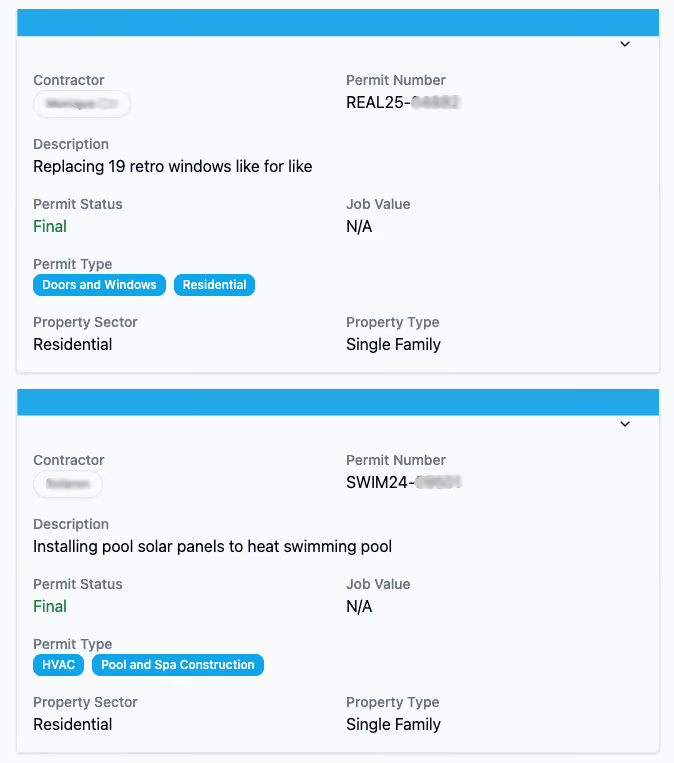
See past and recent permit activity tied to a property, project type, contractor, and date.
Identify homes approaching the end of a system's typical lifespan — roofing, HVAC, and more — based on permit issue dates, right in the window where service, replacement, or underwriting risk review becomes relevant.
Identify major property changes, additions, remodels, repairs, and improvement history.
Review permitted work that may affect property condition, underwriting, or renewal context.
See a contractor's license details and status, activity history, trade specialty, average job value, and contact info — resolved across messy, inconsistent records into one unified profile per contractor.
Understand whether a permit was applied, issued, completed, expired, or otherwise updated where available.
Ways insurance teams use Gryd
Property Risk Intelligence
Use permit history, property changes, contractor activity, and project records to understand how a property has changed over time.
Contractor Verification
Review contractor activity, permit history, license-related signals, project records, and market presence.
Analysis & Data Modeling
Add permit, property, contractor, license, and project signals to models, dashboards, forecasts, reports, and analytics workflows.
Construction Activity Monitoring
Track recent permit activity, project updates, contractor movement, property improvements, and market changes over time.
Technology Integration
Bring verified construction intelligence into products, platforms, workflows, dashboards, AI tools, and internal systems.
Use Gryd in the way your team works
Some teams need a searchable platform. Others need data connected to their systems. Others need large-scale files for analysis, modeling, or research. Gryd gives teams flexible ways to access verified construction intelligence.
Explorer
Search, filter, and monitor permit, property, contractor, and project activity through a web-based platform.
API
Connect Gryd data to your product, platform, model, dashboard, workflow, or internal system.
Bulk Data
Receive large-scale construction, permit, property, and contractor data for analysis, reporting, modeling, or research.
Verified records give insurance teams a different kind of property signal.
Many property data tools show what a property appears to look like today. Gryd helps teams understand what work was permitted, who pulled the permit, and when the record changed.
That difference matters when insurance teams need documented context for underwriting, renewal, claims, fraud, portfolio analysis, or rate adequacy.
Ready to add verified construction activity to underwriting decisions?
Tell us what you're trying to solve, which markets matter, and how your team wants to use the data. We'll help point you toward the right Gryd solution.Tell us what your team needs to understand, which markets matter, and how you want to use the data. We’ll help you find the right Gryd access path.
Insurance & Underwriting FAQs
Question
Answer
How can permit data help insurance underwriting?
Permit data can help underwriting teams see documented property changes, such as roof replacements, renovations, solar installs, HVAC updates, electrical work, plumbing work, additions, and other permitted improvements.
Can Gryd help identify undeclared property improvements?
Gryd can help teams review permit history and property change signals that may point to improvements not reflected in existing policy or property records.
Can Gryd support rate adequacy?
Yes. Permit history and improvement timelines can give teams more context when reviewing whether coverage, pricing, or renewal assumptions match the current property.
Can insurance teams use Gryd for claims or fraud review?
Yes. Teams can use permit, contractor, and project activity data to help validate work, review suspicious activity, or add context during claims and investigation workflows.
Is Gryd only useful for individual property lookups?
No. Teams can use Gryd through Explorer for direct research, API for workflow integration, or Bulk Data for portfolio analysis and modeling.
Can Gryd data integrate with underwriting systems?
Can Gryd data integrate with underwriting systems?