What Is a Building Permit, Really? A Simple Guide for Public Construction Records

Tony Su
What Is a Building Permit, Really? A Simple Guide for Public Construction Records
Article
One of the most underused datasets in American real estate, explained from the ground up.
Overview
If you have ever driven past a construction site and seen a printed sheet zip-tied to a fence or taped inside a window, you have seen a building permit, probably without thinking about what it represents.
A building permit is a government-issued authorization to construct, renovate, demolish, or modify a structure. It is also one of the richest and least used datasets in the real estate and construction economy. The Census Bureau’s New Residential Construction series counted about 1.43 million new privately owned housing units authorized by permit from September 2025 through August 2026. That figure counts housing units, and only new residential ones. It leaves out renovations, commercial work, additions, electrical upgrades, plumbing, HVAC, and most other construction activity. Gryd’s data shows the difference in scale: it recorded more than 1.09 million New Construction permits alone over the same twelve months, and its full dataset spans hundreds of millions of permit records across thousands of jurisdictions.
Key Takeaways
- Building permits are local records, not a national dataset. Gryd sources permits from over 2,500 unique jurisdictions nationwide, each with their own reporting cadence, which gives a sense of how fragmented the source data is.
- Permits are an early signal of construction activity. They are filed before work begins, so they often show activity before completion statistics, listings, or corporate disclosures do.
- A permit is not the same thing as a property or a housing unit. Gryd recorded 1,095,544 New Construction permits from September 2025 through August 2026, while the Census Bureau counted about 1.43 million new privately owned housing units authorized by permit over the same period. The two figures measure different things.
- Permit data has limits. It does not capture unpermitted work, declared valuation is not an appraisal, and an issued permit does not guarantee that a project was completed as filed.
What Is a Building Permit?
A building permit is a document issued by a local government authority, typically a city or county building department, that gives legal permission to begin a specific construction project. Its purpose is public safety. Permits exist so the local building department can review a project’s plans before construction starts, and inspect the work as it happens, to confirm it meets building codes, structural standards, electrical and plumbing codes, and zoning requirements.
Almost any physical change to a structure requires one: new construction, additions and expansions, major renovations, roof replacement, electrical panel upgrades, HVAC and mechanical system replacement, solar installations, pools and decks, and demolition.
Who Issues Building Permits, and Why?
Permitting authority in the U.S. is local, not federal, and that is the main reason the data has been so hard to work with. There is no national permitting agency. Building permits are issued by city building departments in incorporated municipalities, by county building departments for unincorporated areas, and by specialized authorities for categories such as fire safety, environmental review, or historic preservation.
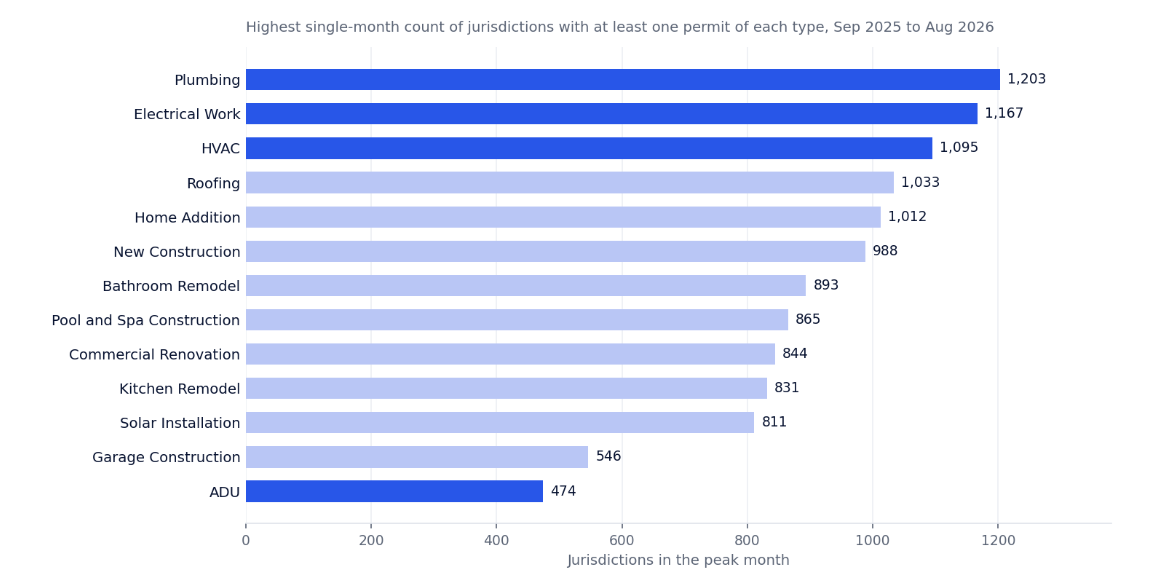
The U.S. does not have one permitting system. It has thousands, each with its own forms, software, fee schedules, and public records policies. That shows up in the data. In August 2026, Gryd received plumbing permits from 1,203 separate jurisdictions, electrical permits from 1,167, and HVAC permits from 1,095. ADU permits, a newer and less consistently labeled category, came from 474 jurisdictions in its peak month. The spread reflects how unevenly different kinds of work are tracked and reported from one place to the next.
This fragmentation is why building permit data has stayed underused for so long. The information is public, but it is scattered across thousands of disconnected systems, each defining its own fields and project categories a little differently.
The Lifecycle of a Building Permit
A permit is not a single event. It is a process that moves through several stages, and each stage leaves a record.
1. Pre-application and design
A property owner, developer, or contractor works with an architect or engineer to develop plans that meet local zoning and code requirements. For larger projects, this stage can include pre-application meetings with the planning department to flag problems early.
2. Application submission
Plans, site surveys, structural calculations, and supporting documents are submitted to the building department, along with permit fees based on the project’s estimated valuation.
3. Plan review
Municipal reviewers, sometimes in several departments at once, check the submission against the applicable codes. This is where most delays happen, and where corrections and resubmissions, often called plan check comments, are requested.
4. Zoning and land use review
Projects that do not conform to existing zoning may need a variance, a conditional use permit, or a rezoning application, which can involve public hearings and added review time.
5. Permit issuance
Once plans are approved, the permit is issued and construction can legally begin. This is the point at which a project shows up in permit datasets as issued, a distinct status from applied for. The gap between the two dates can run from days to many months depending on the jurisdiction and the project.
6. Construction and inspections
As work proceeds, inspectors visit the site at set milestones such as foundation, framing, electrical rough-in, and final, to verify code compliance. Each inspection is typically logged against the permit record.
7. Final sign-off and certificate of occupancy
Once all inspections pass, the project receives final sign-off. New structures and major renovations also receive a certificate of occupancy confirming the building is safe to use.
Every one of these stages generates a timestamped, publicly available data point. That is what makes permit records valuable as a dataset rather than only a compliance document.
Why Permits Are a Leading Indicator in Real Estate
Most indicators used to track construction and real estate describe what has already happened. Building permits are different. They are filed before construction begins, which makes them a leading indicator.
Compare that to the alternatives. Housing starts and completions, and the Census Bureau’s construction spending data, record activity that is already underway or finished, usually with a lag of months. MLS and listing data cover only properties that are for sale or lease, not the much larger universe of owner-occupied and investment properties. Survey data depends on voluntary disclosure and is subject to reporting bias and delay. Corporate capital expenditure disclosures are aggregated at the company or portfolio level, not tied to an address or a date.
Permit counts should also not be treated as interchangeable with housing-unit counts. Gryd recorded 1,095,544 New Construction permits from September 2025 through August 2026, while the Census Bureau counted about 1.43 million new privately owned housing units authorized by permit over the same period. The figures measure different things. A single multifamily permit can authorize dozens of housing units, while a permit record represents one permitted project. Comparing the two directly, without that distinction, leads to wrong conclusions about the scale of construction activity.
What Permit Data Can’t Tell You
Permits capture only work that was filed. Unpermitted work, which is common for smaller renovations in some places, never appears, whether the reason was cost, time, or unfamiliarity with local rules. A permit’s declared valuation is not an appraisal. It is a number the applicant or a fee schedule assigned at filing, and it can understate or overstate the real cost of the work. And an issued permit does not guarantee the project was completed as filed, or completed at all. Plans change during construction, and not every amendment gets its own record. None of this makes permit data less useful as a leading indicator. It does mean treating it as a signal of activity rather than a certified account of what got built.
From Messy Municipal Records to Business Intelligence
Raw permit data is hard to work with. One county’s permit portal might return results as a scanned PDF. A neighboring city might run a modern searchable database. A third jurisdiction might release data only through a public records request. Field names, project categories, and valuation reporting vary from one system to the next, assuming the records are digitized at all.
Turning that into something usable takes direct integration with thousands of building department systems, standardization of inconsistent fields and formats into one schema, ongoing maintenance as municipalities change software or reporting practices, and entity resolution to match contractors, owners, and addresses across records that may spell the same name three different ways.
That is the layer Gryd provides: a standardized, continuously updated source covering 400M+ building permits across 2,500+ U.S. jurisdictions, so that what used to mean checking thousands of government websites by hand is available as one searchable dataset.
Why This Matters
A building permit is more than permission to start construction. It is a timestamped record of what work was planned, where, and often by whom.
The value comes from seeing those records at scale. One permit says something about one property. Millions of permits reveal patterns in construction activity across markets, properties, and contractors.
The challenge is that these records were never built as one dataset. They live in thousands of local systems with different formats, fields, and reporting practices. Making them useful means bringing them together, standardizing them, and keeping them current.
That is the opportunity behind building permit intelligence: turning fragmented public records into information that can be searched, compared, and used to understand what is happening in the built environment.
Curious what building permit intelligence could reveal about your market?
Resources
- Census Bureau, New Residential Construction: https://www.census.gov/construction/nrc/index.html
- Census Bureau via FRED, housing units authorized by building permits, monthly, not seasonally adjusted (PERMITNSA): https://fred.stlouisfed.org/series/PERMITNSA
- Gryd permit records (internal)
Ready to use verified construction intelligence in your industry?
Tell us what your team needs to understand, which markets matter, and how you want to use Gryd data. We’ll help you find the right path.